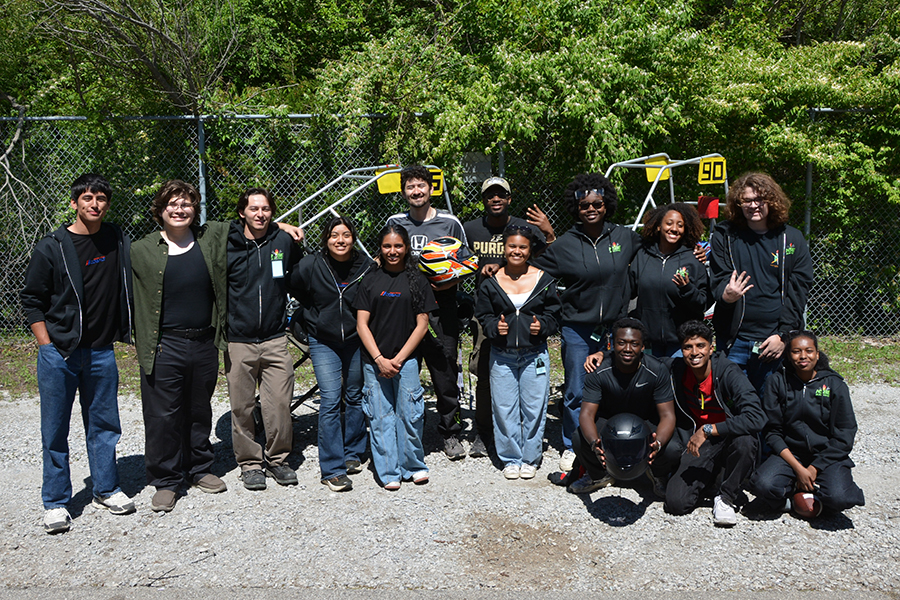
Innovation leads to Grand Prix sprints for NSBE, SWE teams
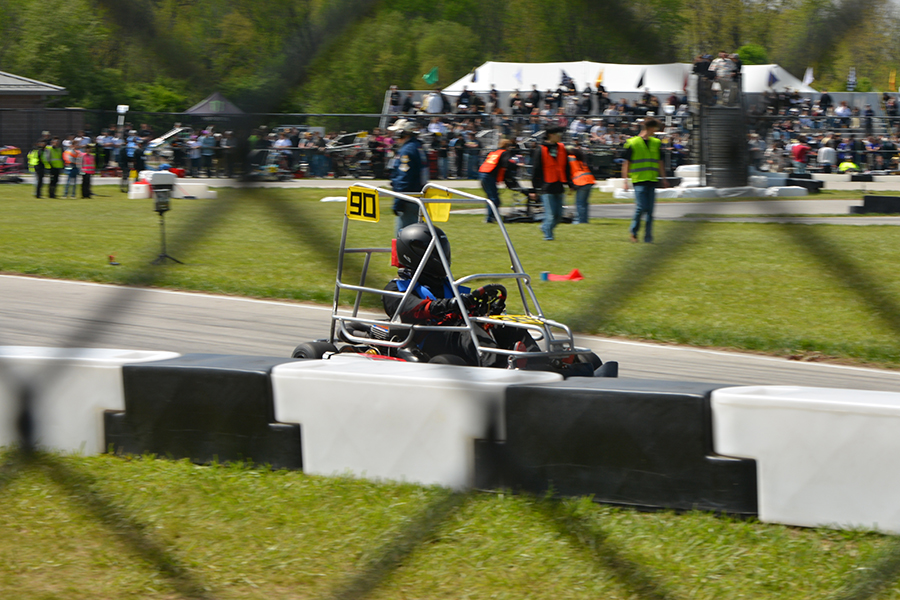
Revving engines cut through the normally quiet West Lafayette Saturday morning.
They didn’t stop until the 33-team Purdue University Grand Prix finished, with 160 laps in somewhere between 90—120 minutes.
Pit crews, data collectors and spectators watched karts race to the checkered flag with anticipation. Who would win? Who would crash? Would the pit crews be able to fix any damage and keep their karts on pace?
As a driver, Mikalah Wiles knows crashing is almost inevitable. But with two years of driving for the Society of Women Engineers (SWE) team, she also knows how to avoid — and when necessary, handle — crashes when they block the track.
Meredith Clark, president of the National Society of Black Engineers (NSBE) Grand Prix team, excitedly anticipates the collisions. Her favorite part of the racing experience, from inception to final race, is when something goes awry.
Which happens often.
“There’s always a problem to solve, day in and day out,” said Clark, a senior in mechanical engineering. “It never gets old.”
The 2026 Grand Prix on April 25 was race No. 69, continuing a tradition that started in May 1958. From the first karts, which ran on lawnmower engines and raced on a gravel track, karts race on a paved course and have become faster and smoother, with Yamaha KT-100 engines on a track refurbished and professionalized in 2009.
The number of competing teams has also skyrocketed from just a handful to 85 teams competing in qualifiers alone. For two weeks prior to the race, those 85 teams took to the track for time trials and sprints. Only the top 27 would immediately qualify. Teams just past the cutoff compete in sprints on race day, where six more could hit the bricks for the Grand Prix that afternoon.
NSBE and SWE both competed in morning sprints to enter the Grand Prix. Both teams had been preparing karts since fall 2025 for the spring race.
“If I wasn’t an engineer, I’d be a racecar driver,” said Wiles, a junior studying industrial engineering in West Lafayette and a member of the Purdue Student Engineering Foundation.
Wiles spent her formative years kart racing in Bloomington, Indiana. Her love of racing was kindled by weekends spent with her dad at Bloomington Speedway and only put on pause due to Wiles’ involvement in high school sports.
It only took a few weeks into the fall 2023 semester for Wiles to discover “The Greatest Spectacle in College Racing,” and put all of her energy into SWE's team.
Clark’s initial encounter with Grand Prix played out similarly during her first semester in fall 2022. She enrolled at Purdue with a plan to study mechanical engineering and a longstanding dream to build a go-kart.
Her random assignment to a go-kart construction team in Vertically Integrated Projects (VIP) was the best coincidence Clark had ever experienced. Not only did the course introduce her to designing and fine-tuning karts, but the course’s teaching assistants were both leaders of Grand Prix racing teams.
Clark joined the NSBE team before the end of the semester. She started as the only first-year student and helped keep the team’s only kart running. It only took half a meeting for Clark to realize that subsystems, mechanics and kart parts were foreign to her. The leaders saw a fresh and enthusiastic student taking the initiative to be a great team member. And how perfect she would be as a student org president.
“From the first day, they trained me to take over and know absolutely everything about the karts and how to make them better so I can teach others,” said Clark, who has been the team president since spring 2024. “(Grand Prix) completely shaped my college experience and has been so rewarding.”
Since then, NSBE’s Grand Prix team has doubled in size. The output of karts has doubled as well. One of the karts was completely reconstructed for competition at Clark’s direction with the hope for a faster, smoother kart that the whole team would be proud of.
The NSBE team recorded one of their fastest times during a sprint, even though they did not quality for the Grand Prix itself.
The qualifiers are important for more than the time trials, according to Clark and Wiles. The practice laps provided the perfect time to improve communication between drivers and pit crews, especially after a crash or malfunction.
“As a driver, you experience a lot of emotions because the adrenaline is running so high,” Wiles said. “My team is always dialing me back, telling me to chill out. I love it. I could not do this without them.”
No matter the track condition, weather or kind of day Wiles has, being in the kart makes any day a good one. The SWE team raced in a pre-Grand Prix sprint, and while they didn’t transfer to one of the 33 racing teams, Wiles was delighted to experience a “clean” race and finish — no major breakage, even after several high-speed crashes.
“If the kart lasts the entire race, that's a good day for me,” Wiles said. “If something happens and I'm out, as long as the team keeps trying their hardest, that's a good day for me. As long as everyone feels like they have done something impactful for the day, whether that be me driving and finishing the race, or my crew chief making the hardest decisions, or the students on the outside doing data ... If everyone feels OK, that's a good day in my book.”