
Springer Engineering Executive Forum illuminates engineering, business intersection
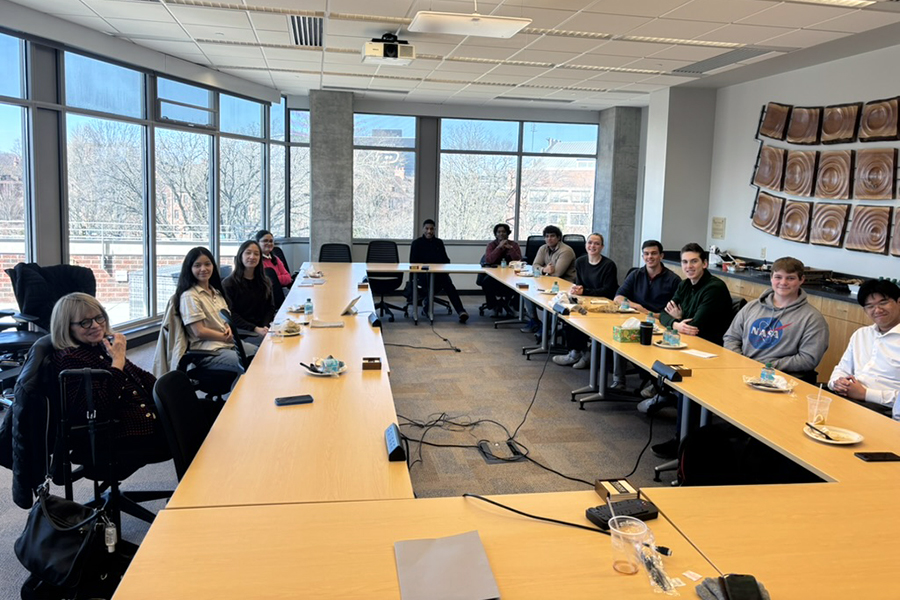
How do engineering students prepare to lead in environments where technical decisions drive real business outcomes?
A new offering within the Purdue University College of Engineering is designed to answer that question.
The intersection of business and engineering will comprise the Springer Engineering Business Experience Certificate, coming in 2027. With a special emphasis on hands-on experiences, students will develop the judgment skills to make valuable real-world decisions, from prioritizing engineering challenges to working across teams. Students will also complete a leadership portfolio, entailing a collection of artifacts that showcase applied learning to demonstrate technical and business readiness.
The certificate includes the Springer Engineering Executive Forum (ENGR 30301), a two-credit course open to all engineering students. Through direct engagement with accomplished executives and Purdue alumni, students gain exposure to engineering’s translation into financial, organizational and strategic outcomes.
“The certificate and courses help engineers develop business judgment through experience,” said Kostas Grigoriou, director of the Springer Business Initiative for the College of Engineering and clinical assistant professor in the Mitch Daniels School of Business. “Students are not just hearing about leadership. They are learning how to frame decisions, navigate tradeoffs and create value in real-world settings.”
A building block of the future certificate, the first iteration of ENGR 303 was implemented in spring 2026. Through class discussions, small-group interactions and informal engagement opportunities, students explored the nonlinear paths to leadership. The skill distilled out of each path, shared by Purdue alums in the course, was the ability to think critically, act decisively and communicate effectively across teams and stakeholders.
“I absolutely loved hearing stories from engineers who use their background in industry to solve problems in the business world,” one student wrote in a post-course evaluation. “It is inspiring to ask questions of people who have been through it and hear their experiences.”
Another student highlighted how the course connected leadership concepts to real situations:
“(A speaker’s) presentation on the grief cycle and how using it to develop the mindset to become a business leader was very engaging and helpful. It was applicable to different situations regarding my personal and professional life.”
Undergraduate engineering students can have direct conversation with executives who began their careers in technical fields and advanced into leadership roles across industries such as technology, energy, consulting, healthcare and finance. These interactions helped students better understand engineering decisions’ organizational impact — and how to contribute early in their careers.
“I was able to have a conversation with (one of the speakers) after his talk to arrange a meeting to talk about my future goals,” another student wrote. “He pursued aeronautical and astronautical engineering with business as I aspire to do.”
Students can register for the fall 2026 section of ENGR 303 during the summer registration window.