From medical school to manufacturing: ME junior Alvarez combines healthcare and engineering in Industry Knowledge Certificate in Pharmaceutical Manufacturing
Sophia Alvarez was going to go to medical school.
Just in case she changed her mind, though, Alvarez came to Purdue for mechanical engineering.
The last thing she expected was to find overlap.
When Alvarez came to Purdue as a first-year student in fall 2023, Alvarez had no idea she’d cross paths with the Office of Professional Practice (OPP) and the Industry Knowledge Certificate in Pharmaceutical Manufacturing, one of three certificates available to Purdue students. And that pursuing it — in tandem with being a Lilly Scholar — would give her the well-rounded medical experience she was looking for through an engineering lens.
Alvarez chose mechanical engineering because of its broad applications, and, thanks to the alumni speakers in ENGR 19400 (Women in Engineering Seminar), she saw engineering as the catalyst to a diverse and fulfilling career in medical field. Biomedical engineering felt like the obvious choice, but she wasn’t as interested in creating medications as she was in optimizing their production.
The following semester in spring 2024, ENGR 10300 (Pharma Careers and Drug Development) reaffirmed what Alvarez had heard in ENGR 194: Engineering was the perfect avenue to expand career horizons.
“I saw that you could do anything (for undergrad) before med school,” said Alvarez, a junior from Pittsburgh. “I wanted a career that I could still enjoy, so I decided to do engineering because it was still very interesting to me.”
The certificate was a bonus. The requirements made sure that Alvarez was able to explore engineering in healthcare through a breadth and depth of experiences on site, picking up in-demand skills and on-the-job experience before graduation.
Engineering threw her future career goal out the window. Alvarez wasn’t pursuing medical school anymore: She wanted to be an engineer.
Though she was surprised at her career pivot, Alvarez learned that it was not rare.
“One of our speakers (in ENGR 194) said they also wanted to go to med school and ended up in engineering,” Alvarez said. “They mentioned that as a doctor or a pharmacist, you're affecting one person at a time. But with engineering, your one solution will affect thousands of people. I never forgot that.”
Alvarez held on to the nugget of wisdom as she navigated challenges in classes and internships. To affect thousands, she had to get comfortable with pushing beyond her limits.
It reminded her of the discipline and determination in marathon training and power lifting, two favorite pastimes that constantly test limits.
“I love finding challenges that I don’t think I can accomplish,” Alvarez said. “ Maybe in the moment it seems crazy, but getting to the goal and looking back, it’s amazing. I can’t believe I was so capable.”
The last line of (product) defense
Alvarez wasn’t sure how she was going to prototype an ankle insert without knowing much about ankles.
But she managed.
Alvarez began a hands-on engineering experience at the Ray Ewry Sports Engineering Center contributing to an ongoing project: As a research assistant, Alvarez helped create an insert that would support the anterior talofibular ligament and avoid ankle injuries while walking, running and jumping in sports like basketball or volleyball, where those kinds of injuries are common. Over five months with professor Jan-Anders Mansson’s undergraduate research group, Alvarez helped increase stabilization by testing new insert materials and improved testing methods to be more realistic for future prototyping.
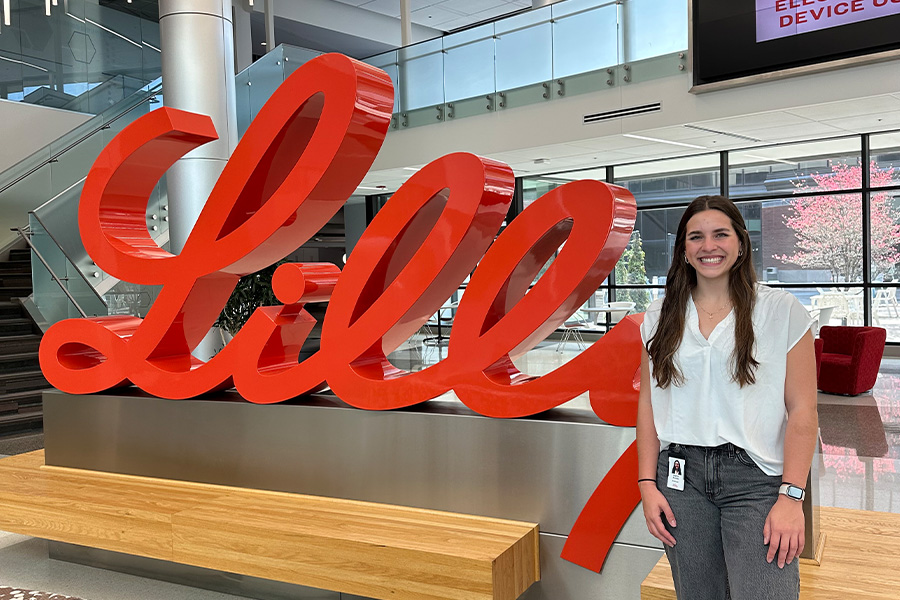
The experience refined what Alvarez looked for during an internship at Eli Lilly and Company in winter and spring 2025 as a part of the Lilly Scholars at Purdue experience. What she wanted was not hands-on creation, but more production based.
It was perfect for the certificate, too.
“The most valuable part — and my favorite part so far — of the certificate is the industry experience. It’s one thing to learn about something in class, but then to actually go do it, see the processes and talk to the engineers is so fulfilling.”
The role at Lilly was the perfect test of Alvarez’s new goal to try out product engineering. As a reliability engineering intern at manufacturing sites, Alvarez was part of a team determined to keep production lines running smoothly and efficiently. Particularly, Alvarez would find replacements for machine parts that were no longer manufactured, called obsolete spare parts, before the parts broke down on the assembly line became a hinderance to getting medications out the door.
Sometimes it was an easy task. Sometimes, it was a quest to find a part that could even similarly fit and function.
Either way, the internship was real-world, everyday engineering.
She loved it.
“I think (the experience) reaffirmed what I wanted to do,” she said. “It showed me that I really enjoyed the people, the culture and the work. I saw that this is an industry that I would feel fulfilled going to work every day.”
Every day was different as an engineering intern. Some days, she was walking the manufacturing floor. Other days, she was scouring the web for replacement parts. Still other days, Alvarez was out and about, tracking down replacements and implementing them with one of the full-time engineers.
The work challenged Alvarez’s fledgling skills as a sophomore. It also challenged her original perception that she would have to be a biomedical engineer to be in the medical field.
“It’s so cool to see (biomedical and chemical) engineers take all this chemistry knowledge and make something that can affect a patient,” Alvarez said. “But even more surprising to me was that a mechanical engineer can help that process by making sure the machines are running perfectly to create those molecules that make the medicine.”
It was easy for Alvarez to apply Lilly learnings during an operations internship at Avery Dennison last summer. Primed with manufacturing experience from the spring, Alvarez leaned into experiences with flagging and replacing obsolete spare parts and worked to improve the company’s material processing line with new equipment and techniques. She was even able to implement a new operating system, compatible with those already in place, complete with early fault detection and autonomous process control logic.
Alvarez’s experiences are exactly the kind the pharma certificate aims to encourage, said Kimberly Graham, OPP’s senior program manager for pharma and the Lilly Scholars at Purdue program.
“Having completed internships at Eli Lilly and Company and Avery Dennison and with experience as an undergraduate research assistant, Sophia brings both technical insight and professional maturity to her learning,” Graham said.“I’ve seen her grow significantly throughout her time here at Purdue thus far, becoming a thoughtful, confident engineer ready to make an impact in the pharmaceutical manufacturing space and in peoples’ lives.”